

New entrants into strawberry cultivation often bring valuable experience from other protected cropping systems, and this should not be discarded. Many have already grown crops such as lettuce, tomatoes, cucumbers, or herbs in coir based substrates and are familiar with irrigation, fertigation, EC, pH, and drainage management; huge advantage when going into strawberry cultivation.
However, one important detail is often missed when moving into strawberries:
Untreated coir is not automatically ready for strawberry production.
In many cases, the coir must first be properly hydrated, washed, buffered with calcium, rinsed again, and then pre-charged with the correct strawberry nutrient solution before planting.
This is not just a technical formality. It is an important step that directly affects root establishment, nutrient uptake, plant balance, and early crop performance.
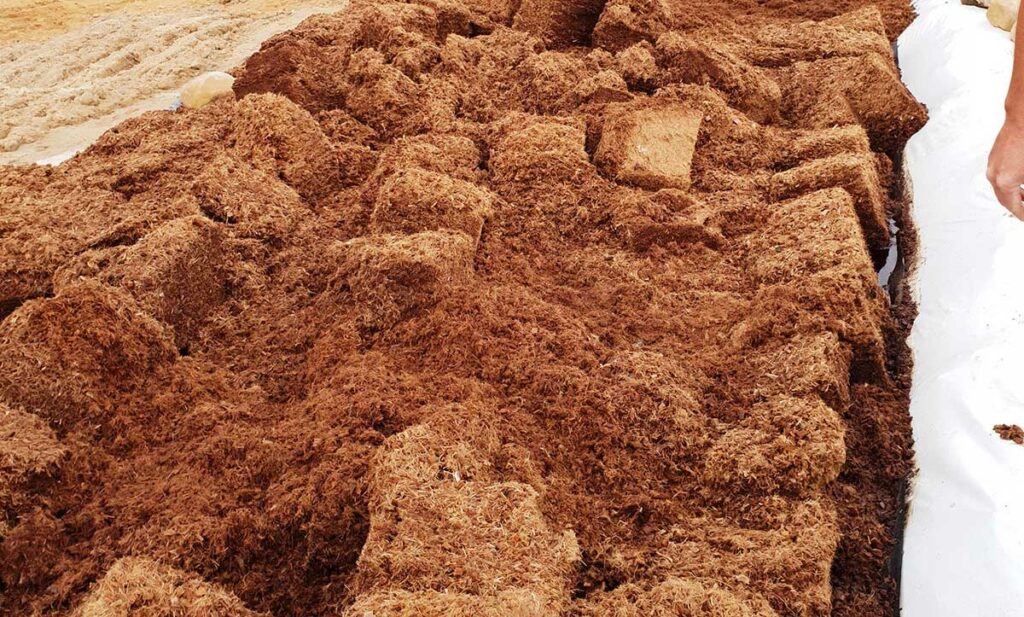
Why this is often missed
Growers with experience in lettuce or tomatoes may assume that coir behaves in the same way across crops. In practice, strawberries are particularly sensitive during establishment. The crop has a relatively shallow and fine root system, and young plants can respond quickly to poor root zone conditions.
Our focus should not only be whether the coir can hold water or drain well, but also how the provided nutrients react chemically, affecting their availability to plants.
Untreated coir can contain high levels of soluble salts, especially sodium (Na) and potassium (K). Coir also has a high cation exchange capacity, which means that it can hold positively charged nutrients and salts on exchange sites within the substrate. If these exchange sites are loaded with Na and K, they can very easily released into the root zone during irrigation and fertigation.
This can create several problems for strawberries.
High sodium and high EC can make it harder for the plant to take up water. Excess potassium can compete with calcium and magnesium uptake. Calcium is essential for root growth, cell wall strength, leaf and crown development, and fruit quality; and strawberries have an expected and very often realised risk of tip burn (calcium deficiency) that would need additional foliar Calcium spray applications during establishment to minimise symptoms.
Magnesium is central to chlorophyll formation and photosynthesis. If the substrate chemistry is not stabilised before planting, the fertigation programme may look correct on paper, but the plant may still struggle to take up nutrients in the right balance.
This is why washing and buffering coir is so so important.
Washing versus buffering
Washing and buffering are related, but they are not the same process.
Washing removes the free soluble salts from the coir by flushing the substrate with clean, low EC water; preparing the substrate for the buffering and making buffering more efficient..
Buffering uses a calcium source, commonly calcium nitrate, Ca(NO₃)₂, to replace sodium and potassium on the coir exchange sites with calcium. Once Na and K are displaced, they must be removed through drainage and final rinsing.
In simple terms:
Washing removes salts that are already soluble.
Buffering helps remove salts that are held on the coir exchange sites.
Both steps are important.
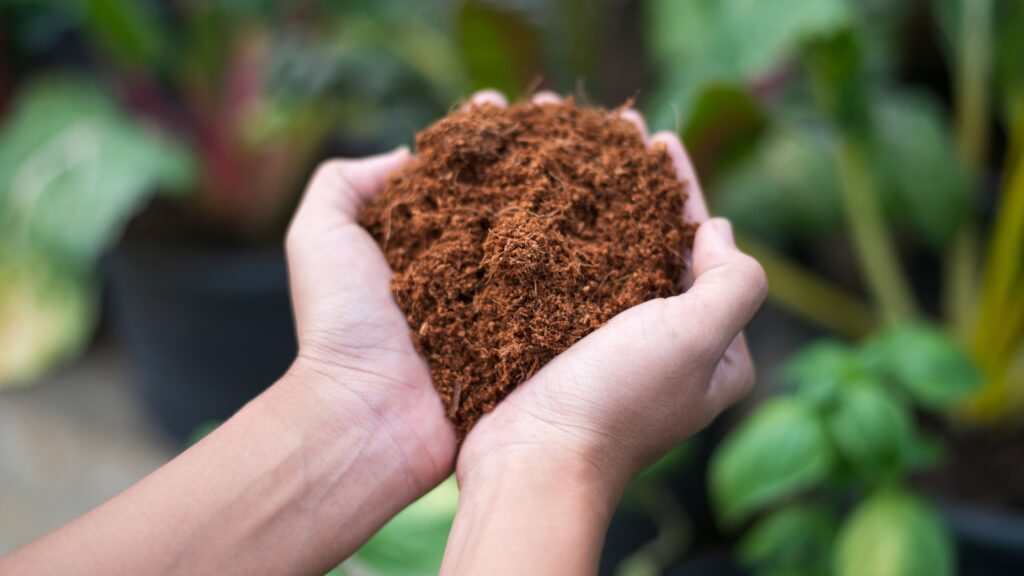
What does the research show?
A useful paper by Gbollie, Mwonga and Kibe, published in the Journal of Agricultural Chemistry and Environment, evaluated calcium nitrate rates and soaking durations for treating cocopeat. The study tested 0, 60, 100 and 150 g calcium nitrate in 15 L water with 1.5 kg cocopeat, across soaking durations of 12, 24, 36, 48 and 72 hours.
The authors reported that 100 g Ca(NO₃)₂ in 15 L water per 1.5 kg cocopeat, soaked for 36 hours, was effective for reducing potassium and sodium in the treated cocopeat. This treatment reduced K by approximately 78.44% and Na by approximately 92%, while also supplementing calcium and nitrogen.
This treatment is equivalent to:
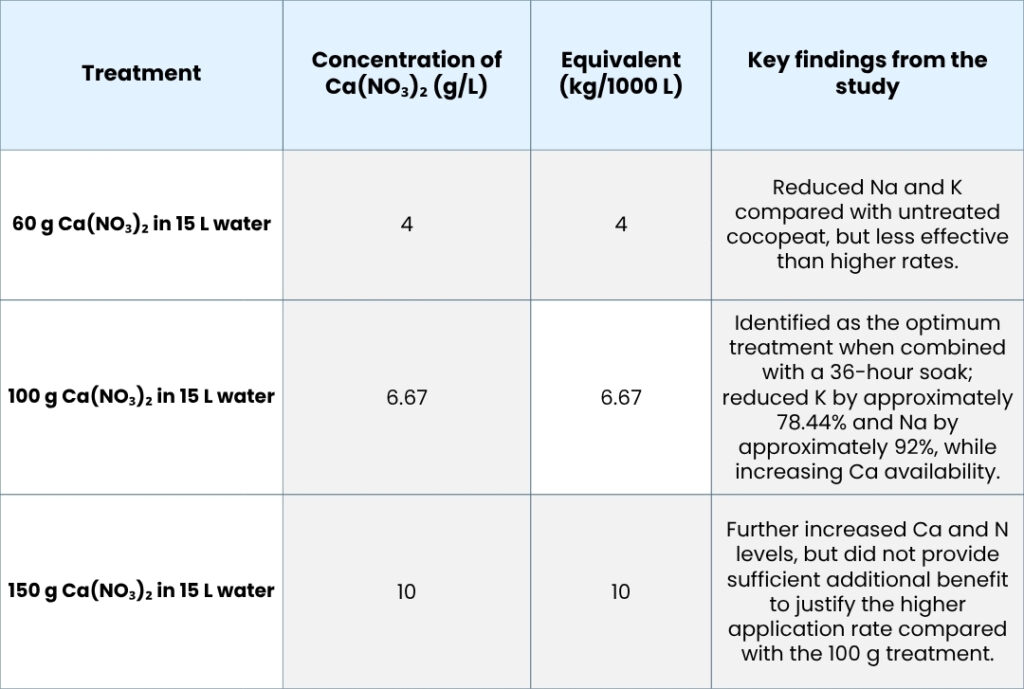
This gives a useful reference point for commercial strawberry production, especially when the coir source is untreated, unknown, or potentially high in salt.
Commercial coir preparation guidance
Commercial coir suppliers also recommend hydration, washing and buffering before use where coir is not already prepared. Many explain in depth that proper hydration, washing and buffering help reduce salt levels and improve nutrient balance before the substrate is used for commercial crop production.
A commonly used commercial buffering concentration is:
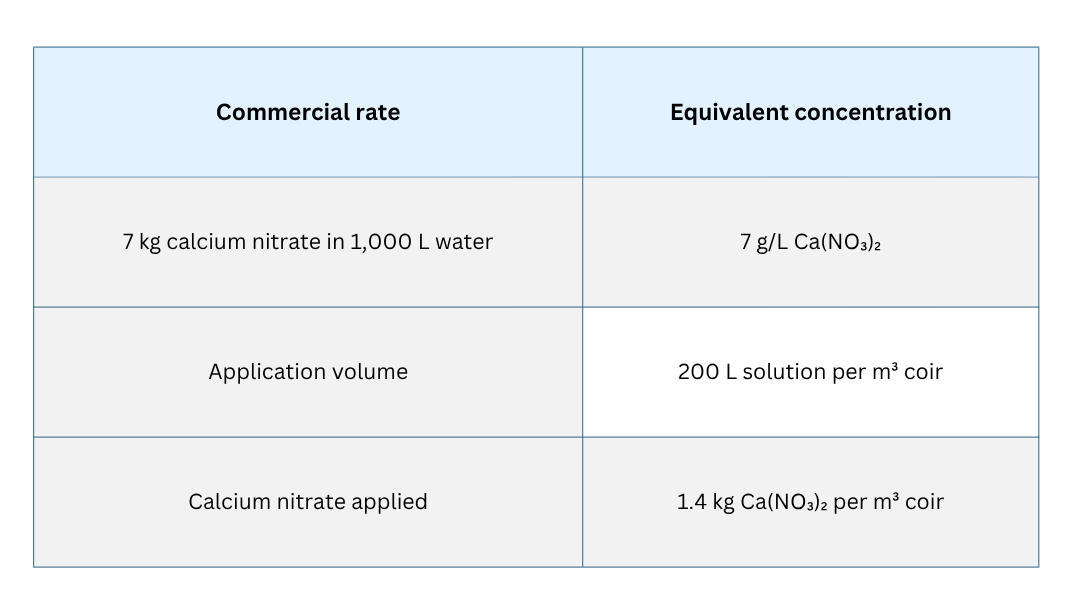
The important point is that the grower should not only think about the concentration in the tank. The volume of solution applied, the contact time, the initial salt content of the coir, and the final rinse all matter.
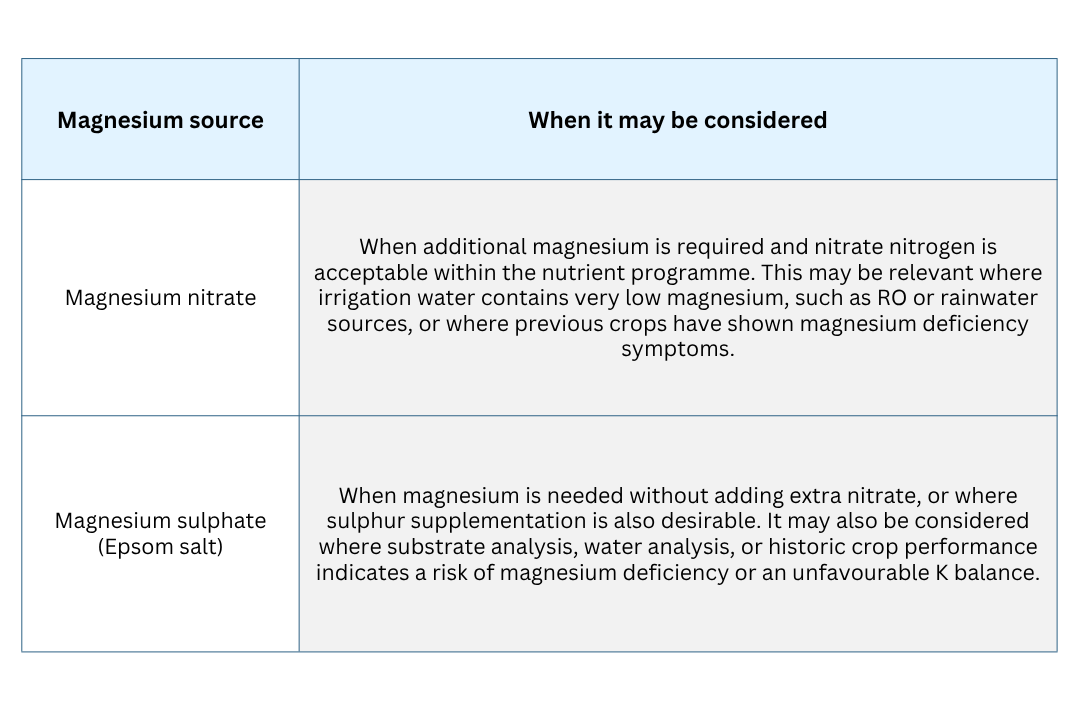
When to Consider Magnesium During Coir Buffering
In some situations, growers may also consider including magnesium during the buffering process. While calcium nitrate remains the primary and most widely recommended buffering agent, magnesium can be beneficial where the coir is untreated, of unknown origin, or where irrigation water is very soft, such as rainwater or reverse osmosis (RO) water.
Magnesium may be supplied as magnesium nitrate [Mg(NO₃)₂] or magnesium sulphate (MgSO₄). Both can help occupy exchange sites in the coir and improve the calcium–magnesium balance in the root zone, particularly where substrate analysis indicates low magnesium levels or a high potassium-to-magnesium ratio.
As a general guide:
Practical target range
For untreated coir intended for strawberry production, a practical calcium nitrate buffering range is:
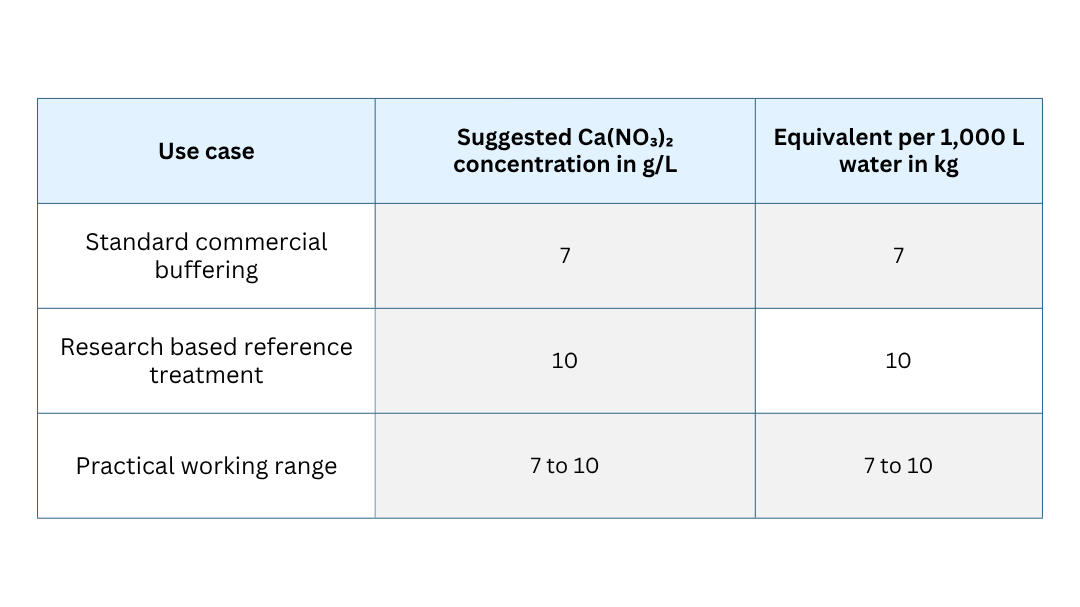
For standard commercial preparation, use approximately:
200 L buffer solution per m³ of coir
For coir of unknown origin, high EC coir, or coir that has not been professionally washed and buffered, it is advisable to test the substrate and send a sample for analysis.
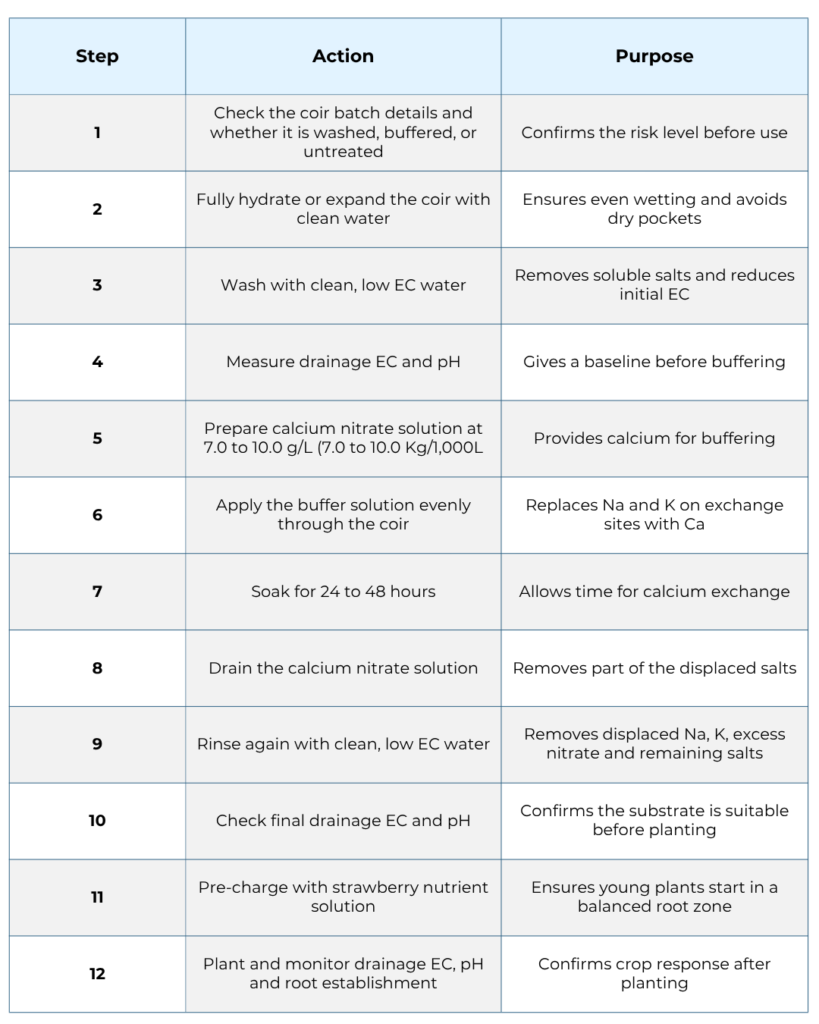
Steps to follow before planting strawberries into untreated coir
What should growers monitor?
After treatment and planting, growers should continue monitoring the root zone closely, especially during the first 1 to 2 weeks.
Important checks include:
- Irrigation EC and pH
- Drainage EC and pH
- Drainage percentage
- Root growth
- Leaf colour
- New leaf development
- Signs of marginal scorch or salt stress
- Signs of calcium or magnesium imbalance
A good start in strawberries depends heavily on a stable root zone. Once young plants are stressed by high EC, poor calcium availability, or unstable substrate chemistry, the effect can carry through into crown development, flowering, fruit set and fruit quality.
Final message
Coir can be an excellent substrate for strawberry production, but it should not be treated as an inert material with no chemical behaviour. It is an organic substrate that holds and releases nutrients and salts, and this matters greatly during strawberry establishment.
For new strawberry growers, especially those coming from lettuce or tomato production, the key message is simple:
Do not assume untreated coir is ready for strawberries. Wash it, buffer it, rinse it, test it, and only then plant into it.
The cost of doing this properly is small compared with the cost of poor establishment, uneven growth, nutrient imbalance, and lost early, or even all yield.
Relevant work
Botanicoir (2026) How to prepare and use coco coir: Buffering and hydration explained. Available at: https://www.botanicoir.com/how-to-prepare-coco-coir-for-commercial-growing/ (Accessed: 30 May 2026).
COCOX (2025) How to buffer coco peat. Available at: https://cocox.in/how-to-buffer (Accessed: 30 May 2026).
Gbollie, S., Mwonga, S. and Kibe, A. (2021) ‘Effects of calcium nitrate levels and soaking durations on cocopeat nutrient content’, Journal of Agricultural Chemistry and Environment, 10, pp. 372–388. Available at: https://www.scirp.org/journal/paperinformation?paperid=111507 (Accessed: 30 May 2026).
Lichen Group (2025) How to buffer coco coir. Available at: https://www.lichengroup.co.za/how-to-buffer-coco-peat/ (Accessed: 30 May 2026).
Ohio State University (2019) Controlled environment berry production information: Substrate systems. Available at: https://u.osu.edu/indoorberry/substrates/ (Accessed: 30 May 2026).
Small Fruits Consortium (2024) Soil-less substrates for greenhouse strawberry production. Available at: https://smallfruits.org/2024/04/soil-less-substrates-for-greenhouse-strawberry-production/ (Accessed: 30 May 2026).

Katia Zacharaki Kouloumprouka
Director – Plant Scientist
Hello, I am Katia, founder and director of InnoPhyte Consulting! I specialise in TCEA strawberry cultivation, offering comprehensive support from business strategy to everyday operations, backed by scientific expertise.
If you need to talk to me, feel free to get in touch at katia@innophyte.co.uk
Science Support
Data Analysis
TCEA strawberries
Project Manager
Hydroponics