
5 Steps to Get Started
If you have an idea that you think can make a difference to on-farm growing, but aren’t sure how to turn it into a funded application for the Innovate ADOPT competition, there are five easy steps to help you get started below.
In our opinion, some of the best ideas start with a fairly simple thought:
“There must be a better way to do this”
Maybe you’ve spotted a way to possibly improve productivity. Maybe there’s a technology you’ve been wondering whether you could trial on your farm. Or perhaps you’re dealing with a problem that doesn’t seem to have a straightforward solution.
That’s where the ADOPT competition comes in.
The Accelerating Development of Practices and Technologies (ADOPT) Fund supports farmer-led, on-farm trials and demonstrations. The aim is to test new ideas and generate practical evidence that can help farmers, growers and foresters decide whether those ideas could work for them too.
With Full ADOPT Grant: Round 10 now open (and more to follow when this round closes), there’s up to £5 million available, with individual projects able to receive between £50,000 and £200,000.
But where do you actually start?
1. Start with the problem, not the funding
Before you start thinking about how much funding you could receive, think about the challenge you want to solve.
ADOPT is looking for projects that address a real on-farm or immediate post-farmgate challenge or opportunity, with the potential to improve areas such as “productivity, resilience or sustainability”.
Your idea also needs to be something that can be tested in a real farming, growing or forestry environment.
That doesn’t necessarily mean you need to have invented something completely new.
Previous ADOPT projects have covered a surprisingly broad range of ideas.
For example, one project is testing an AI-powered bird deterrent system using computer vision, drones and adaptive deterrents to tackle crop damage in brassica and salad production. Another is looking at whether computer crop modelling can improve nitrogen use efficiency, with the work being tested across several farming businesses and different soil types.
The common thread isn’t that these projects are all using cutting-edge technology.
It’s that they’re tackling real problems faced by farmers and testing whether a different approach could work.
So, start here:
What problem are you trying to solve?
It can help to write this down in a sentence or two before you start thinking about the application itself.
For example: “We are experiencing X problem, which is affecting Y, and we want to find out whether Z could provide a better solution.”
Starting with the problem helps keep the project focused on what you are actually trying to learn, rather than simply trying to find a way to fit an interesting technology into a funding application.
Think about how developed your idea already is
It is also worth considering whether your idea is ready to be tested on farm.
ADOPT is designed around testing and demonstrating new ideas or solutions in real farming conditions. It is not intended to take a very early laboratory concept through basic research and initial technical development before it is ready for an on-farm trial.
You don’t necessarily need to use Technology Readiness Level terminology in your application, but the principle is important.
Ask yourself: Is the idea developed enough that a meaningful on-farm trial can actually take place?
If the technology or practice still needs significant technical development before you can test it in a real farming environment, another funding route may be more appropriate.

2. Get support early
Once you’ve got an idea, you don’t necessarily need to work everything out yourself.This is where a facilitator can make a real difference.
In fact, getting some advice early can help you work out whether your idea is suitable for ADOPT, what needs developing and who you might need to involve.
There are several different types of support available through ADOPT, and it’s worth understanding the difference between them.
The simplest way to think about it is:
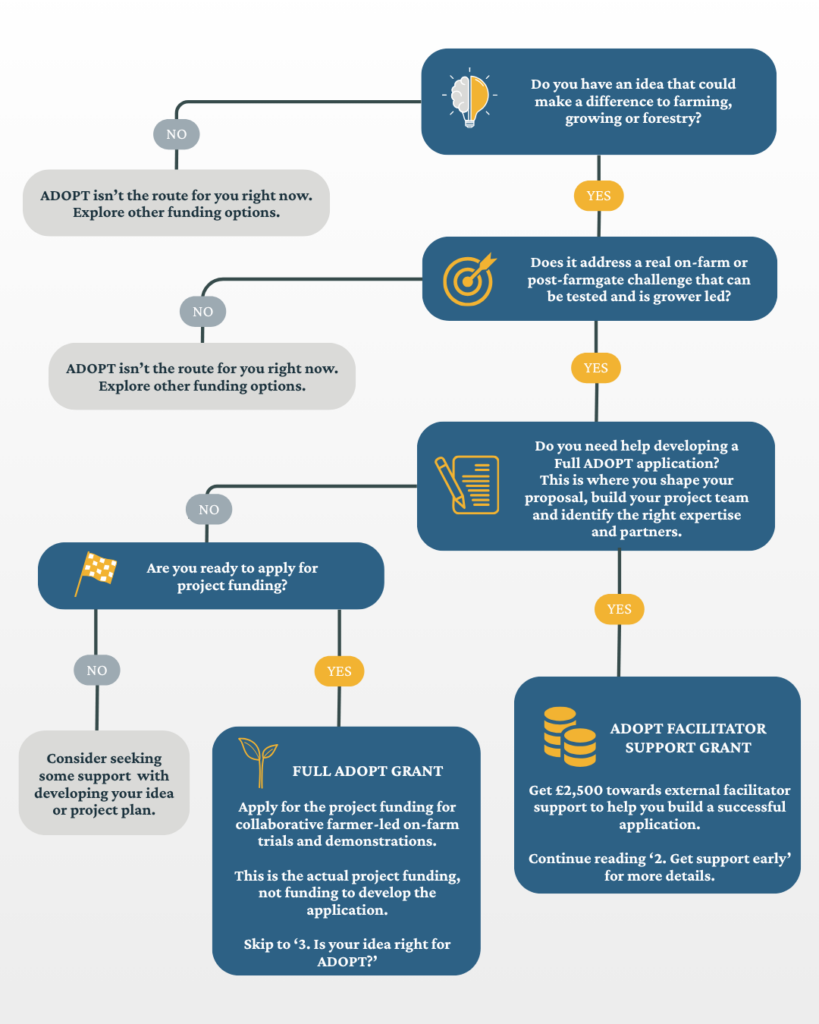
If you already have a promising idea and want more hands-on help developing a Full ADOPT application, the ADOPT Facilitator Support Grant can help eligible farming, growing and forestry businesses in England engage an external Project Facilitator. The grant is worth £2,500 and is specifically designed to support the development and submission of a Full ADOPT Grant application.
You don’t have to receive the Facilitator Support Grant to apply for Full ADOPT. Equally, you don’t need to have a fully formed project before asking for advice.
At InnoPhyte, this is where we think facilitation can make a real difference.
It’s not simply about helping to write an application. A good facilitator can work with you to develop the idea itself, challenge assumptions, identify gaps, find the right expertise and partners, and shape a project that can produce useful results.
The aim is to build the right project first, and then build the application around it.
If you’re not sure where to start, have a free conversation with one of our ADOPT registered facilitators.
According to Dr Jim Stevens, InnoPhyte Consulting’s Senior Innovation Consultant and an Innovate UK Approved ADOPT Facilitator:
“Writing strong applications takes skill and effort. I’ve learned, sometimes the hard way, what works and what doesn’t.”
Working with someone who has successfully been through this process, from start to finish, many times sets you up for a successful application.
3. Is your idea right for ADOPT?
Once you’ve identified the problem, it’s worth taking a step back and asking whether ADOPT is the right funding route for your idea.
This is another point where speaking to a project facilitator early can be useful. They can help you look at the idea from a practical perspective, challenge your assumptions and work through whether it is at the right stage for an ADOPT project.
Is your idea ready to be tested on-farm?
ADOPT is focused on testing and demonstrating innovations in real farming, growing or forestry environments. Your idea therefore needs to be sufficiently developed to be meaningfully trialled in practice.
It is not intended for basic research or for taking an early lab-based concept through its initial technical development. As a practical guide, your innovation should be beyond the very early stages of development and ready to move towards testing in a real-world setting.
Technology Readiness Levels (TRLs) can be a useful way of thinking about this, even though specific TRL numbers are not stated as formal ADOPT requirements. The important question is whether the innovation is developed enough to be properly tested in an on-farm setting.
Is a farmer, grower or forester at the heart of the project?
ADOPT is designed around farmer-led, on-farm trials and demonstrations. The farming, growing or forestry business should therefore be central to the project, rather than simply providing a site for someone else’s research.
Think about who has identified the problem, who will help shape the trial and who will use the results. A strong ADOPT project should be driven by a real need within the farming, growing or forestry sector.
Can you design a robust trial?
A strong trial design is one of the most important practical aspects of an ADOPT application.
You should be able to clearly explain:
- What is the current challenge?
- What are you proposing to test?
- How will you test it?
- What will you measure?
- How will you know whether the approach has worked?
- What will the results tell you?
The trial needs to be designed in a way that produces useful and credible evidence, rather than simply demonstrating that something can work in one particular situation.
A good ADOPT project should also be able to learn from the results, including when something doesn’t work as expected in a robust and consistent way. For example, a trial might show that a particular technology works well in one situation but not another. Understanding why can be just as useful as demonstrating a successful outcome.
Will the results help other farmers?
This is a critical part of an ADOPT project.
ADOPT isn’t just about finding something that works on one farm. The programme is designed to generate knowledge and evidence that can be shared more widely, helping other farmers, growers and foresters make decisions about whether an idea could work in their own businesses.
That means your application needs a clear plan for how the results will be shared with other farmers and how the findings could encourage wider adoption.
Think beyond simply publishing a final report. Who needs to hear about the results? How will you reach them? What information will they need to decide whether the approach could work for them?
A strong dissemination and adoption plan should be considered from the beginning of the project, rather than added at the end.
Ultimately, a good ADOPT project should answer two questions:
a) Can we learn something useful by testing this in practice?
b) And how will that learning help other farmers decide what to do?
If your idea is still very early-stage, needs significant technical development or is primarily a research project, there may be another funding route that is a better fit. Getting advice early can help you work this out before you invest time in developing a full application.
4. Turn a good idea into a strong project
Once you know that your idea is a good fit for ADOPT, the next step is turning it into a clear, practical project.
A good ADOPT application needs to show that you’ve thought through what the project will actually involve, who needs to be involved and how the work will be delivered.
Think about the practical side:
- Where will the trial take place?
- Who needs to be involved?
- What will each partner contribute?
- What exactly will you compare or measure?
- What evidence will you collect?
- How long will the project need to run?
- What could affect the results?
- How will you manage those risks?
- How will the findings be shared with other farmers?
These details help turn an interesting idea into a credible project that can generate useful evidence.
It’s also worth thinking about your project team early. ADOPT projects must be farmer-led, but the farmer, grower or forester doesn’t have to have all the expertise needed to deliver the project themselves. Bringing in the right partners, researchers, technical specialists or other businesses can strengthen the project and help you answer the questions you are trying to test.
Your project should also be realistic. Think about what you can actually achieve within the project time frame, what resources and expertise you need, and whether the proposed trial will generate meaningful results.
And remember that the application needs to make sense to someone who isn’t living with your problem every day. You might know exactly why something matters on your farm, but the application needs to explain the problem, the proposed solution and the value of testing it clearly to the assessor.

5. Tell a clear story
Once you’ve developed the project, your application should take the reader through a clear and logical journey.
- Here’s the problem we’re trying to solve.
- Here’s the idea or approach we’re proposing.
- Here’s why it is worth testing.
- Here’s how we’re going to test it.
- Here’s what we’re going to measure and learn.
- Here’s how we’ll share the results and help other farmers understand what they mean.
The different parts of the application should all connect back to this story.
Don’t be tempted to over complicate things just because you’re applying for funding. Clear, practical and specific is usually much more useful than trying to make the project sound complicated.
Most importantly, make sure you’re answering the question being asked. It can be easy to focus on everything you know about your idea, rather than the information the application actually needs.
So, what makes a good ADOPT idea?
There isn’t one type of project that ADOPT is looking for.
The existing portfolio shows how varied the ideas can be, from crop production and nutrition to machinery, technology, pest management and everything in between. What they have in common is that they start with a genuine challenge and involve testing a potential solution in real-world conditions.
A good ADOPT idea therefore doesn’t necessarily need to be complicated or completely new. It needs a clear problem, a reason to test the proposed approach, a farmer-led project and the potential to generate useful evidence that can be shared more widely.
So, if you’ve been thinking “I wonder if this would work?”, it might be worth exploring.
You don’t need to have every detail worked out before you start a conversation. But you do need to be able to explain the problem you’re trying to solve, what you want to test and why the results could be useful to other farmers, growers or foresters.
Could we help you develop your ADOPT application?
The Full ADOPT Grants are open, with up to £200,000 available for eligible on-farm trials and demonstration projects.
At InnoPhyte, we see facilitation as more than simply helping to write an application.
Our experienced facilitators can work with you from the early stages of developing an idea, helping you test whether it is a good fit, shape the project, identify the expertise and partners you need, and develop the application.
The aim is to build a strong project first, then build the application around it.
If you’re considering an ADOPT application and would like to talk through your idea, get in touch with the InnoPhyte team below: